Generative engine optimization services: what an audit should include
In short
A good audit from generative engine optimization services tests real buyer questions in the AI tools your buyers use, records who each answer names and cites, checks that those tools are allowed to read your site, and ends with a ranked list of fixes. Counts and dated answers, not a single score.
Seeing this on your own site? Send us the address for a free site check, and a written report comes back within 2 business days.
Key points
- "Generative engine optimization" comes from a research paper first posted on 16 Nov 2023 and accepted to KDD 2024.
- An audit should test named engines with a fixed set of buyer prompts and report counts per engine.
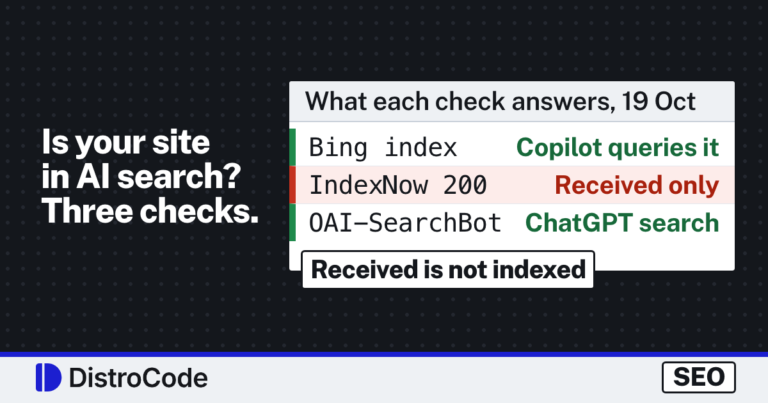
- It should check crawler access engine by engine: OpenAI uses one robots.txt name for ChatGPT search (OAI-SearchBot) and another for model training (GPTBot).
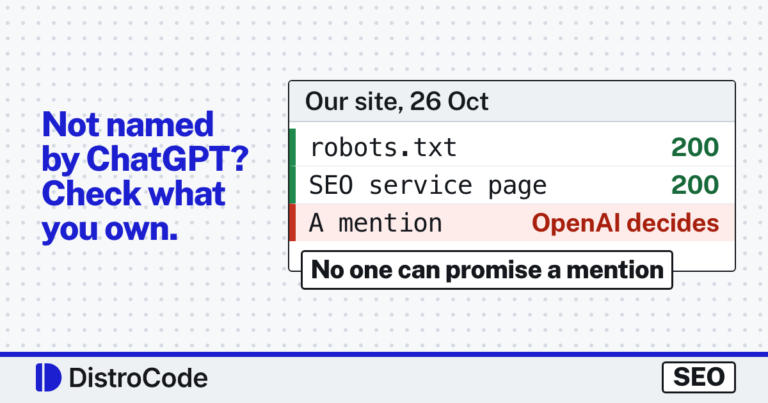
- No one can promise you a citation. Google states that meeting every requirement does not guarantee a page is served.
On this page (9)
- What are generative engine optimization services?
- Where does the term generative engine optimization come from?
- What should generative engine optimization services test, and in which engines?
- How many prompts make a fair test?
- What should you get at the end?
- What did we find when we audited our own site?
- Which promises should make you walk away?
- Where should you start?
- Questions and answers
What are generative engine optimization services?
Generative engine optimization services are sold under several names: GEO, AEO, AI SEO, AI search visibility. Under the names, the useful part is the same. Find out what the AI tools say about your kind of business today, find out why your site is or is not in those answers, and fix the reasons you control.
This post sets out what that audit should contain, so you can judge any offer, ours included. Our SEO and AI search fixes are where the fixing happens once the audit is done.
Where does the term generative engine optimization come from?
Generative engine optimization is the work of making a site easier for AI answer tools to find, read and cite. The term was introduced in “GEO: Generative Engine Optimization” by Aggarwal and co-authors, posted to arXiv on 16 Nov 2023 and accepted to KDD 2024.
The paper calls these tools generative engines: systems that gather sources and summarize them into one answer. In its own benchmark, the authors report that their methods raised a source’s visibility in those answers by up to 40%, and that what worked varied by subject. That second finding matters more for a buyer than the first. There is no single trick that works for every trade.
For a service business, the practical version is narrower. When someone asks an AI tool “who can fix my WooCommerce checkout” or “best WordPress developer in Toronto,” does your business come up, and if not, who does?
What should generative engine optimization services test, and in which engines?
They should test the engines your buyers actually use, by name, and say which ones. The four we would expect to see are ChatGPT, Perplexity, Google AI Overviews and Gemini.
For each engine, the audit records three things per prompt: whether your business is named, whether your site is linked as a source, and which other businesses or sites are named instead. The last column is often the most useful. It tells you whose pages the engines trust for your topic.
Then the audit should look at your site from the engine’s side:
- Crawler access. OpenAI’s crawler page says OAI-SearchBot is what surfaces sites in ChatGPT search, and that sites opted out of it “will not be shown in ChatGPT search answers.” GPTBot is a separate setting for model training. A site can block one and allow the other, in robots.txt or in a server rule, as our post on AI crawlers blocked on WordPress shows with status codes. For Google, its guide names robots.txt rules for Googlebot as the control.
- Indexing. Google’s guide says a page must be indexed and eligible for a snippet to appear as a link in AI Overviews or AI Mode.
- The opening of each key page. Does the first paragraph answer the question the page is for?
- Schema that matches the page. Google asks that structured data match the visible text. It also says no special schema is needed for its AI features.
Our SEO and AI search fixes work on these same parts of a site: indexing, titles and headings, schema, internal links and llms.txt.
How many prompts make a fair test?
Enough to see a pattern, few enough to rerun by hand. We plan for 20 to 30 buyer prompts across the four engines. Fewer than about ten and one odd answer swings the whole result. Hundreds of prompts look thorough but are rarely rerun, so you never learn whether a fix worked.
The prompts should be the questions your buyers type, in their words. Mix three kinds:
- the service and place (“WordPress maintenance company in Melbourne”);
- the problem (“WooCommerce orders stuck on pending payment, who can fix it”);
- the comparison (“Squarespace or WordPress for a dental practice site”).
Every answer needs a date next to it. AI answers change from week to week, and an undated screenshot proves nothing a month later.
What should you get at the end?
Three things you can use without the seller in the room.
The results table. Prompts down the side, engines across the top, and in each cell “named and cited,” “named” or “not named.” Underneath, plain counts: named in 3 of 20 answers, for example, with the split per engine. Counts you can check beat a “visibility score” whose formula you cannot see.
The prompt sheet. The exact prompts, so you or anyone else can rerun them next month and compare.
A ranked fix list. Each finding tied to a page and a line, in the order that matters: anything that blocks crawling first, then indexing, then the page openings, then schema and links.
What did we find when we audited our own site?
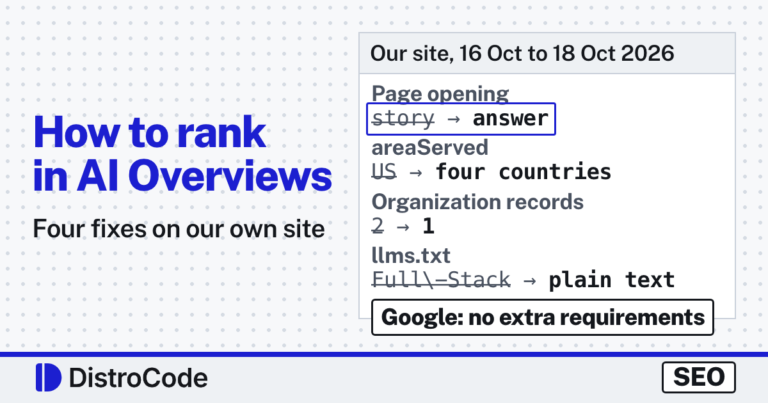
On 16 Oct 2026 we ran the site side of this audit on distrocode.com. The counts were not flattering:
- 0 of 9 service pages named the four countries we serve (the US, Canada, Australia and New Zealand), and every Service schema record said “US” only.
- 2 of 9 service pages opened with a story instead of the answer.
- 0 body links pointed into any service page from our blog posts.
- The About page printed a second Organization record with the same ID and a different name.
- Our llms.txt had a backslash before every full stop, dash and ampersand (
Full\-Stack).
We read the live site again on 18 Oct at 12:30 PM ET. The schema on the About and maintenance pages named all four countries, and the About page carried one Organization record. The maintenance page led with its answer. llms.txt was plain text listing services, countries and contact details, and robots.txt blocked nothing.
The prompt side of the audit, the part that shows who the engines name, gets run against the fixed site so the before and after are measured the same way.
Which promises should make you walk away?
Guaranteed citations or rankings in ChatGPT or AI Overviews. Google’s own guide says that a page meeting every requirement still may not be crawled, indexed or served. No seller controls what an engine picks.
A score with no prompts behind it. If you cannot see the questions and the dated answers, you cannot check the number or rerun it.
llms.txt sold as the main fix. Google says you do not need AI text files to appear in its AI features. A clean file is fine to have. It is not a strategy.
“Fixes” that block the crawlers you need. Some security plugins and CDN bot settings can turn away AI crawlers, and Google’s guide names your CDN and host, not only robots.txt, as places crawling gets blocked. An audit that never reads your robots.txt and firewall rules has missed the first check. We covered a related lockout in why a Squarespace site is not showing on Google.
Where should you start?
Start with what can lock you out, because it costs nothing to check. Read your robots.txt, confirm your key pages are indexed in Search Console, and read the first two sentences of each service page.
If you want us to look, ask for a free site check. You get a written report within 2 business days on speed, links and forms, mobile layout and search. No call, no login, nothing changed on your site.
To ask about an AI search audit or the fixes, tell us what you sell and where you sell it.
Where did these facts come from?
- Aggarwal, Murahari, Rajpurohit, Kalyan, Narasimhan, Deshpande, GEO: Generative Engine Optimization (arXiv 2311.09735, submitted 16 Nov 2023, accepted to KDD 2024), checked Oct 18, 2026
- OpenAI, Overview of OpenAI crawlers (OAI-SearchBot for ChatGPT search, GPTBot for training, about 24 hours after a robots.txt update), checked Oct 18, 2026
- Google Search Central, AI features and your website (last updated 10 Dec 2025), checked Oct 18, 2026
- DistroCode, our audit of distrocode.com (16 Oct 2026) and the live re-read of the About page JSON-LD (18 Oct 2026), checked Oct 18, 2026
- DistroCode, live re-read of the WordPress maintenance page opening and Service schema (18 Oct 2026), checked Oct 18, 2026
- DistroCode, llms.txt and robots.txt as served (free site check scope and reply time; no Disallow rule), checked Oct 18, 2026
Questions and answers
What is the difference between GEO and SEO?
SEO aims at a ranked list of links; GEO aims at being named or cited inside an AI answer. The foundations overlap: Google says the same SEO best practices apply to its AI features as to Search overall.
Which AI engines should a GEO audit cover?
The ones your buyers use. ChatGPT, Perplexity, Google AI Overviews and Gemini are the four an audit should cover. It should name each engine and report results per engine.
Does blocking GPTBot remove me from ChatGPT search?
Not by itself. OpenAI's documentation treats GPTBot (training) and OAI-SearchBot (search) as independent settings. Blocking OAI-SearchBot is what keeps a site out of ChatGPT search answers.
How long after a robots.txt change does ChatGPT notice?
OpenAI says it can take about 24 hours for its search systems to adjust after a robots.txt update.
Can an audit guarantee my business will be cited?
No. Engines choose their sources, and Google states that indexing and serving are not guaranteed even when a page meets every requirement.
Still stuck? Send us the page address and what you see Want to know if the problem stops here? Ask for the free site check.
We write up one real fix or build a few times a week. Follow DistroCode on LinkedIn