React JS development services: a buyer’s guide for custom web apps
In short
React JS development services build the screens of a custom web app: booking flows, dashboards and a login for each kind of user, over a back end that stores the records. You need one when a WordPress site can no longer hold your rules. Expect a written brief first, then a quote per project.
Seeing this on your own site? Send us the address for a free site check, and a written report comes back within 2 business days.
Key points
- React draws the screens. Records, logins and payments live on a back end, usually Laravel in our builds.
- Nuxt and Next.js can send public pages as finished HTML from the server. Screens behind a login rarely need that.
- On 25 Oct 2026 our test React app sent a crawler 453 bytes of HTML and an empty root div. The heading was only in the JavaScript.
- A custom app is quoted per project. The kinds of user, the screens, payments and connected systems move the price.
On this page (9)
- What do React JS development services include?
- When does WordPress stop being enough?
- Should a business app use React, Vue or Nuxt?
- Does the back end need Node.js or Next.js?
- How is a custom web app scoped and priced?
- Can Google index an app built in Bolt or v0?
- How do you move a vibe-coded app without losing search?
- Have an app in mind?
- Questions and answers
React JS development services build the screens people use in a custom web app: the booking form, the staff dashboard, the login for each role. This guide covers what those services include, how React compares with Vue and Nuxt, and how a build is scoped and priced. It follows how we run our custom web app development projects.
DistroCode has delivered over 300 projects since 2017, web apps among them.
What do React JS development services include?
The screens, plus the planning that decides what goes on them.
React calls itself “the library for web and native user interfaces”. It draws a booking calendar or an order table and responds when someone clicks. It does not store the bookings. That is the back end’s job, and in our builds the back end is usually Laravel.
So a React build from us covers both halves:
- The screens. Booking flows, payment steps, dashboards, and a separate login and view for each kind of user.
- The back end. The database, your rules, payments and links to the systems you already use.
- A try before launch. You see the app working first, and nothing goes live until you say so.
- A written note. What we built, where it runs, and anything waiting on a decision from you.
When does WordPress stop being enough?
When the site has to work something out for each person instead of showing everyone the same page.
WordPress with the right plugins covers brochure pages, contact forms and an ordinary store, and it costs less to run. The signs it is running out: prices that depend on the customer, bookings paid in installments, and staff and clients who each need their own login.
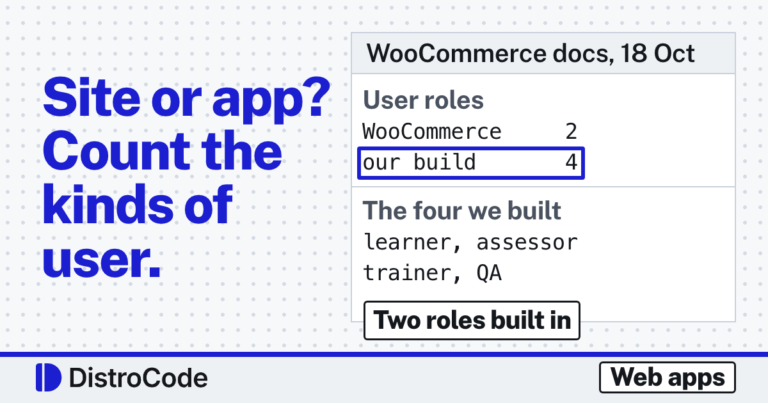
Our post on when a custom web app beats a website sets one of our builds, a training platform with four roles, against WooCommerce’s documentation. When a site would be enough, you hear that from us before any app quote.
Should a business app use React, Vue or Nuxt?
Any of them can carry one. The real questions are who will maintain it, and whether its pages must be found on Google.
On our Work page, two apps pair React screens with Laravel. One takes event bookings paid in four parts; the other trains and assesses lift engineers. We offer Vue for new apps, though no project on our Work page uses it yet.
Next.js goes with React, and Nuxt goes with Vue. Both can build a page on the server so it arrives as finished HTML. Nuxt’s docs say it does this by default “to optimize search engine indexing”. In Next.js, pages are Server Components by default.
Our rule of thumb: public pages that must be found get Nuxt or Next.js, and screens behind a login can stay plain Vue or React. If your team already runs one, that usually decides it.
For the Vue side, our guide to Nuxt.js development services shows when plain Vue is enough and how one Nuxt app serves public pages and private screens from the same code.
Does the back end need Node.js or Next.js?
No. Next.js runs on Node.js (React’s docs say it deploys to “any hosting provider that supports Node.js”), and it can fetch data on the server, but it need not be the whole back end.
For records, logins and payments, our usual back end is Laravel. Node.js is on our stack list too, and we pick by what the project needs and what your team runs.
How is a custom web app scoped and priced?
From a written brief, then a quote per project. A quote tool with one form and a booking system with payments are different jobs, so there is no set price.
Four things move the price: the kinds of user, the screens each one needs, payments, and the systems the app has to talk to. A good brief answers three questions:
- Who uses the app?
- What does each of them need to see?
- Is there a date you are working toward?
We reply in writing within one working day, Monday to Friday, with our questions. The quote then names the price, the scope, what is left out and a date. If the work grows past it, we stop and ask first.
That brief, the quote and the build, React or Vue screens over a Laravel back end, is the work we do on every custom web app.
Can Google index an app built in Bolt or v0?
It can, but check what the first response holds. Whether the app came from Bolt, v0 or a developer, what matters is where its pages are drawn.
On 25 Oct 2026 we built a one-page React app with Vite and fetched it with curl, as a crawler’s first request does. The HTML was 453 bytes. Its body was an empty <div id="root"></div>, and the title read “spa”. The heading “Book your event” lived only in a 219.7 kB JavaScript file. The same request to our own service page returned its H1 in the first response.
Google can still render it. Its JavaScript guide says a page may wait in the render queue “for a few seconds, but it can take longer than that”. It also notes that “not all bots can run JavaScript”, and calls server-side or pre-rendering “still a great idea”.
To test your own app, open a page, choose View Source and search for a sentence you can see on screen. If it is not there, the page shows nothing until JavaScript runs.
How do you move a vibe-coded app without losing search?
Keep every address that already gets traffic, or redirect it.
Before any rebuild, list every page address the old app serves. After the move, each one works as it did or 301 redirects to the page that replaced it, and the old app stays up until the new one has been checked. Our guide to moving a site without losing SEO covers the address list and the redirects.
If the app is mostly public pages, a rebuild on Nuxt or Next.js, or a move to WordPress, puts the words in the first response. We cannot promise rankings. We can keep the addresses Google already knows working.
Have an app in mind?
Describe the app you need: the people who will use it and what each one must see. We reply in writing within one working day, Monday to Friday.
Already live and missing from Google? Send the address for a free site check. It covers custom web apps, React ones included, and the written report arrives within 2 business days.
Where did these facts come from?
- DistroCode, custom web app development (Laravel back end; React, Next.js, Vue or Nuxt screens; quoted per project after a written brief; what moves the price; hosting optional), checked Oct 25, 2026
- DistroCode, services ("Built with: Laravel, React, Vue, Next.js, Nuxt.js, Node.js and DigitalOcean servers"), checked Oct 25, 2026
- DistroCode, free site check (covers custom web apps, including ones built in Laravel and React; written report within 2 business days), checked Oct 25, 2026
- DistroCode, website migration (page address list before a move; each old address works or redirects; no ranking promise), checked Oct 25, 2026
- Google Search Central, Understand JavaScript SEO basics (render queue "can take longer than that"; "not all bots can run JavaScript"; server-side or pre-rendering "is still a great idea"; last updated 2026-03-04), checked Oct 25, 2026
- Nuxt docs, Rendering Modes ("By default, Nuxt uses universal rendering ... to optimize search engine indexing"), checked Oct 25, 2026
- Next.js docs, Server and Client Components ("By default, layouts and pages are Server Components"), checked Oct 25, 2026
- React docs, react.dev ("The library for web and native user interfaces") and Creating a React App (Next.js deploys to "any hosting provider that supports Node.js"), checked Oct 25, 2026
Questions and answers
How much do React JS development services cost?
Each app is quoted per project after a written brief. The kinds of user, the screens, payments and connected systems move the price, and the quote names the scope, what is left out and a date.
Do I need Next.js or Nuxt for SEO?
For public pages you want found, it helps. Both can send a page as finished HTML from the server, and Google's own JavaScript guide calls server-side or pre-rendering "still a great idea". Screens behind a login rarely need it.
Is React or Vue better for a business app?
Either can carry one. We pick by what the project needs and what your team already runs. Two apps on our Work page have React screens, and we offer Vue for new apps.
Will Google index my Bolt or v0 app?
It can, after rendering, but the first response may be an empty page. Open View Source and search for a sentence you can see on screen. If it is missing, ask for our free site check, which covers custom web apps, React ones included.
Still stuck? Send us the page address and what you see Want to know if the problem stops here? Ask for the free site check.
We write up one real fix or build a few times a week. Follow DistroCode on LinkedIn